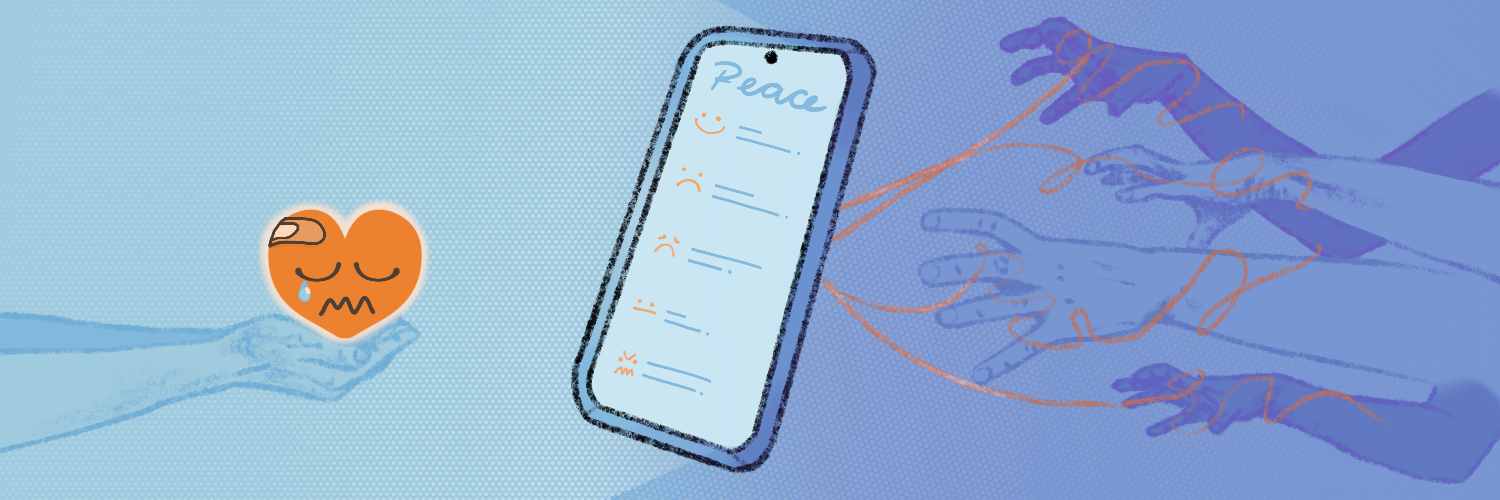
banner by Addyson Cochran
Your Mental Health App Is Collecting More Than Your Feelings
by Varnujah Rengaramanujam Kanagaraj
It is a Tuesday night. You have a midterm next week, two assignments you haven't started, dance practice in an hour, and a group project meeting you've been dreading. You tell yourself you'll just scroll Reels for five minutes. You open Instagram, and the first thing that pops up is an ad for a mindfulness app: a calm interface, soft colors, and the promise that it will help you breathe through the chaos. You download it. You start typing.
Sound familiar? For many college students, this isn't a hypothetical scenario – it's a common response to the constant stress of school and life.
Pitt students are not imagining the pressure. Between classes, jobs, clubs, and relationships, stress is less an occasional visitor and more a permanent roommate. A Fall 2024 national survey by the American College Health Association covering more than 33,000 undergraduates found that 78 percent of students had experienced moderate or high stress within the past 30 days, and roughly one in five were experiencing serious psychological distress.
Despite these statistics, in-person therapy on a college budget is not always realistic. Waitlists at counseling centers can stretch for weeks, and a single out-of-pocket session with a private therapist typically runs $100 to $250. So, when an app promises similar relief for $9.99 a month (or free with ads), the appeal is obvious. It fits in a backpack, has no lines or receptionist, and is available at 2 a.m., which is when many students actually need it. The widening gap between the support students need and the support they can easily access is exactly the space mental health apps have rushed to fill.
Mental health apps are no longer a niche product. They are an industry. Grand View Research valued the global mental health apps market at $7.5 billion in 2024, projected it to reach $8.9 billion in 2026, and forecast it will hit $17.5 billion by 2030, growing at an annual rate of 14.6 percent. There are now more than 20,000 mental health-related apps available across app stores: mood trackers like Bearable and Daylio, meditation apps like Calm and Headspace, AI chatbot "therapists" like Woebot and Replika, teletherapy platforms like BetterHelp and Talkspace. The pitch across nearly all of them is the same: convenience, privacy, and lower costs than traditional care. For a stressed-out student typing into a phone at midnight, that pitch works.
Here is the part that rarely gets a second thought mid-download: these apps do not just sit there quietly helping you breathe. To function and to make money, they collect a lot of data, including user-written mood logs and journal entries, sleep patterns, location, device identifiers, and, in therapy-adjacent apps, intake questionnaires asking about depression history, substance use, sexuality, and trauma. None of this is necessarily sinister on its own; it is expected that the Sleep app would need to know when you are asleep. But taken together, this is some of your most sensitive personal information, collected by companies that, unlike your doctor's office, are not always bound by the regulations you would assume.
Almost nobody reads the privacy policy before downloading an app. A 2019 Pew Research Center report, "Americans and Privacy: Concerned, Confused and Feeling Lack of Control Over Their Personal Information," found that more than a third of adults say they never read a privacy policy before agreeing to one, and fewer than one in ten always do. Compounding this is a widespread myth among students that anything dealing with health is automatically protected under HIPAA, the federal law that governs medical privacy. It generally is not. HIPAA's privacy rule applies only to "covered entities," meaning traditional healthcare providers, insurers, and vendors that work directly with them. An app you download yourself from the app store, even one that discusses your physical and mental health, is typically not a covered entity. That means it can legally share, sell, or use your information in ways a hospital or licensed therapist's office cannot.
Perhaps the most well-known example of this kind of data sharing is the online therapy platform BetterHelp. In 2023, the Federal Trade Commission finalized a $7.8 million settlement against BetterHelp, one of the largest online therapy platforms in the world, after finding it had shared users' email addresses, IP addresses, and answers to health questionnaires with Facebook, Snapchat, Pinterest, and the ad-tech company Criteo, despite explicitly promising users their information would stay between them and their counselor. Roughly 800,000 people were later notified that they were eligible for a partial refund. The Mozilla Foundation's ongoing privacy research supports this on a broader scale. Its reviews of mental health and wellness apps have repeatedly found that the majority fail to meet basic privacy and security standards – more than any other product category the organization has examined. In one recent cycle, 28 of 32 apps tested received a privacy warning label. Even nonprofits are not immune. Crisis Text Line, the free crisis-counseling text service promoted to students by many universities, spent years sharing anonymized conversation data with Loris.ai, a for-profit company the platform had co-founded to train customer-service chatbots for businesses. Public backlash in 2022 ended the arrangement, but the case is a reminder that even organizations built on trust may monetize what people say in their most vulnerable moments.
It is important to acknowledge that if this data is ever exposed, the fallout does not affect everyone equally, and the consequences extend well beyond any one campus. Mental health apps often market directly to teens and young adults, the age group most likely to experience anxiety and depression and least likely to read a privacy policy before tapping "I agree." Data shared in a moment of acute distress is not the same as browsing history for sneakers, and it cannot be unshared. Jennifer Kamrass, a nurse practitioner in Florida, learned this after she used Talkspace, a therapy app offered through her employer's benefits program, to process the stress of a job loss while nearly nine months pregnant. Two years later, she sued that same employer for pregnancy discrimination, and its lawyers obtained a court order compelling Talkspace to produce the complete transcript of everything she had typed to her therapist. The records were entered into evidence and ultimately caused the court to rule in the employer's favor. Nothing about that disclosure broke any law; the platform simply wasn't required to keep Kamrass's information private, as an in-person therapist's notes might be. Apps that ask about sexual orientation, gender identity, immigration status, or substance use can resurface later in a lawsuit, a background check, or a data breach, with the person who disclosed it having no say in the timing or the audience.
A college student seeking relief for anxiety about a midterm and someone disclosing a crisis to a hotline do not face identical risks. But they are using products built on the same business model, where sensitive emotional data has become a monetizable asset. That model should be understood by anyone considering using these services.
The goal here is to ensure that students choose tools with open eyes. Before downloading, check whether the privacy policy clearly states whether data is sold or shared for advertising, and whether the company has responded publicly to any privacy findings against it. Ask yourself whether you would be comfortable with an advertiser or insurer reading a given journal entry or viewing your survey responses. PTSD Coach, built by the U.S. Department of Veterans Affairs, and Wysa have both been repeatedly cited by privacy researchers as trustworthy. University resources, including Pitt's Counseling Center and its crisis line, are bound by different and generally stronger confidentiality standards than a consumer app ever will be.
Mental health apps can genuinely help, and plenty of students use them well. But helpful does not mean harmless. Right now, this industry is asking users to trust it with their most sensitive information while operating with far less oversight than most people assume. So, the next time an app promises peace of mind, it is worth asking what it expects in return.